Mortgage Rate Education
APR vs. Interest Rate: What Each Number Means on a Mortgage
Decorative graphic based on the example in this article; the labeled chart appears below.
When you compare mortgage offers, you see two percentages: the interest rate and the APR. They measure different things, and the gap between them tells you something about the fees attached to the loan.
This guide explains what each number includes, why the APR is usually higher, and where the APR can mislead you.
The short version
The interest rate is what you pay each year to borrow the money. It sets your monthly principal-and-interest payment. It does not include fees.
The annual percentage rate (APR) is a broader measure. The Consumer Financial Protection Bureau describes it as reflecting the interest rate plus points, mortgage broker fees and other charges you pay to get the loan. Because it includes those costs, the APR is usually higher than the interest rate. CFPB: interest rate vs. APR
Where to find each number
On a Loan Estimate, the interest rate is on page 1 under Loan Terms. The APR is on page 3 under Comparisons, next to two other useful figures: the total you will have paid in the first five years, and the Total Interest Percentage (TIP), which is the total interest over the life of the loan as a percentage of the loan amount. CFPB: Loan Estimate explainer
What the APR includes, and what it leaves out
The APR is built from the loan's finance charge, which federal rules define. On a mortgage, it generally includes interest, discount points, loan origination and similar lender fees, and mortgage insurance premiums that protect the lender. Regulation Z, 12 CFR 1026.4
Several common closing costs on a home loan are excluded, as long as they are bona fide and reasonable:
- title examination, title insurance and survey fees,
- fees to prepare loan documents such as the deed and the mortgage,
- notary and credit report fees,
- appraisal and pre-closing inspection fees, including pest and flood determinations, and
- money paid into an escrow account, such as reserves for property taxes and homeowners insurance.
So two loans with the same APR can still have different cash-to-close totals. The APR is about the cost of the credit, not every check you write at closing.
A worked example
Here are two hypothetical offers for the same $400,000, 30-year fixed loan. They are not quotes, and the rate reduction for the point is an assumption chosen to show the math:
- Offer A: 7.32% interest rate with $1,500 in lender fees. Principal and interest: $2,747.72 a month. APR: about 7.36%.
- Offer B: 7.07% interest rate with one discount point ($4,000) plus the same $1,500 in lender fees. Principal and interest: $2,680.04 a month. APR: about 7.21%.
For context, 7.32% was Freddie Mac's national average for a 30-year fixed loan in its October 22, 2026, survey. Freddie Mac PMMS
Offer B has the lower APR and saves $67.68 a month. On paper, it looks like the better deal.
The APR assumes you keep the loan for its full term
The APR spreads the upfront fees across all 30 years of the loan. Most people sell or refinance well before that. When the loan ends early, the upfront fees are spread over fewer years, and the true yearly cost is higher than the APR shows.
That matters most for the offer with more upfront cost. In the example:
- Keep the loan 3 years: Offer B costs about $980 more than Offer A.
- Keep it about 4 years: the two come out roughly even.
- Keep it 5 years: Offer B costs about $1,040 less.
- Keep it 10 years: Offer B costs about $6,100 less.
These totals count the fees, the payments and the remaining balance you would pay off when you sell or refinance.
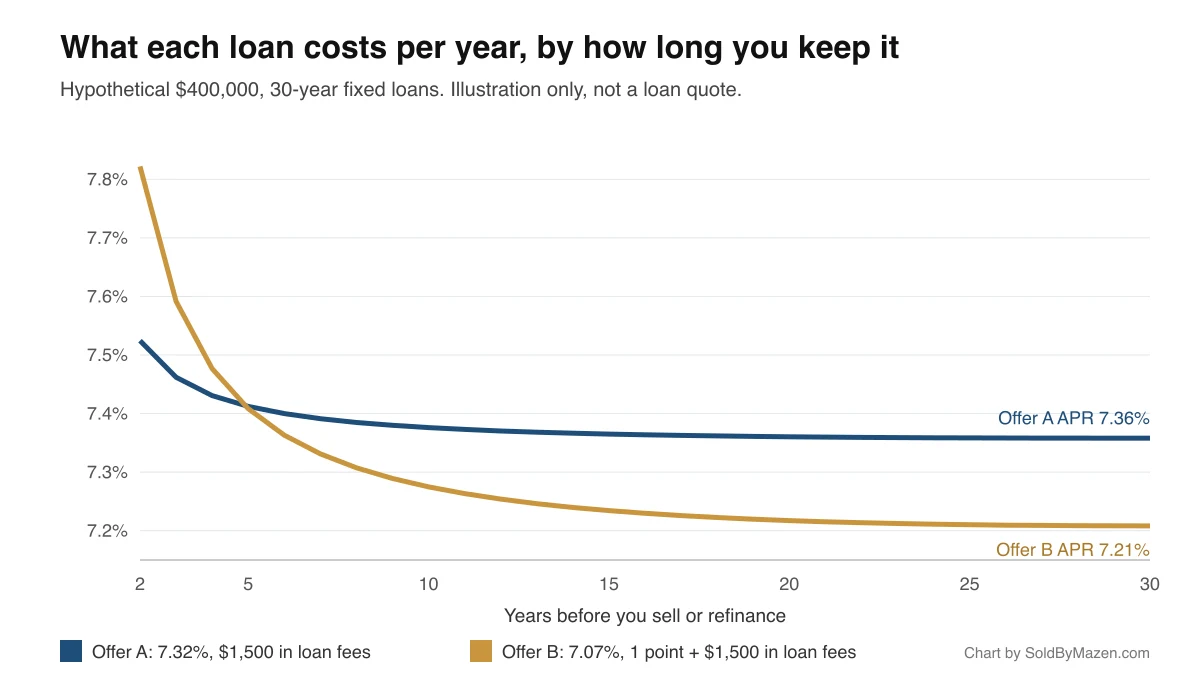
The lower APR was right in the long run, and wrong if the loan ends early. That is the same trade-off covered in how mortgage points and break-even math work.
Other places the APR can mislead
- Adjustable-rate loans. The CFPB notes that an ARM's APR does not reflect the maximum rate the loan could reach. Be careful comparing a fixed-rate APR with an ARM APR, or one ARM with another.
- Different loan types. A home equity line of credit's APR does not include fees, so it is not directly comparable with a mortgage APR.
- Different fee choices. If one offer includes points and another includes a lender credit, the APRs will differ for reasons that have more to do with your timeline than with which lender is cheaper.
The CFPB's advice is not to look at the APR alone when deciding which loan makes the most sense for you.
If the APR changes before closing
Your final numbers appear on the Closing Disclosure, which you must receive at least three business days before closing. If the APR changes enough to become inaccurate under federal rules, generally by more than one-eighth of a percentage point for a typical fixed-rate loan, the lender must give you a corrected Closing Disclosure and a new three-business-day waiting period before you close. Regulation Z, 12 CFR 1026.19(f)(2)(ii) and 12 CFR 1026.22
If the APR on your Closing Disclosure looks different from your Loan Estimate, ask your lender why before closing week.
How I help buyers compare offers
When buyers have Loan Estimates from more than one lender, I tell them to look first at how many points each rate is costing. I also have them ask every lender for a quote at the par rate, the rate with no points. That way we can compare the fees each lender charges and see who is most competitive without a buydown mixed in.
I don't let buyers choose a loan on an advertised rate alone. We run the numbers together, the lender, the buyer and me, before they decide.
I suggest getting Loan Estimates from at least three lenders, so they compete for your business and you can see who offers the better deal. In reality, most buyers go with the first lender they apply with.
Questions to ask your lender
- What is your par rate (the rate with no points), and what are your fees at that rate?
- What fees are included in this APR, and which closing costs are not?
- Can you show me the same loan with no points, with points and with a lender credit, priced on the same day?
- If I keep the loan for five years instead of thirty, which option costs less?
- On an adjustable-rate loan, what is the highest rate the loan could reach, and when?
- Is my rate locked, and would anything change the APR before closing?
The APR is a useful starting point for comparing offers. Your own timeline, and the full list of fees on page 2 of the Loan Estimate, finish the comparison.
For related reading, see mortgage rate locks explained and why mortgage rates don't always follow the Fed.