Mortgage Rate Education
Mortgage Rate Locks Explained: Periods, Extensions and Float-Downs
Decorative graphic based on the timeline example in this article; the labeled chart appears below.
A mortgage rate lock holds your interest rate between the loan offer and closing. It protects you if rates rise before you close, but it has an end date, and it does not cover every change to your loan.
This guide explains how locks work, what happens when closing runs past the lock, and the questions worth asking before you lock.
What a rate lock is
A rate lock is the lender's commitment to a specific interest rate, and usually a specific price in points or credits, for a set number of days. If you close within that window and nothing material about the loan changes, the locked terms apply even if market rates move.
The Consumer Financial Protection Bureau says locks are typically available for 30, 45 or 60 days, and sometimes longer, and that each lender sets its own policies. CFPB: what is a rate lock
A lock works in both directions. It protects you if rates rise, and it can keep you from getting a lower rate if they fall after you lock, unless your lock includes a float-down option.
Where the lock shows up on your paperwork
Check the top of page 1 of your Loan Estimate. It shows whether the rate is locked and, if so, until what date and time. Some lenders lock the rate when they issue the Loan Estimate, and some do not.
If your rate was not locked when you got the Loan Estimate, federal rules require the lender to send a revised Loan Estimate no later than three business days after you lock, showing the locked rate, points, lender credits and other rate-dependent charges. CFPB: Regulation Z, 12 CFR 1026.19(e)(3)(iv)(D) That revised estimate is a good moment to compare the numbers with what you were quoted.
Choosing a lock period
Longer locks give you more room if closing is delayed, but a longer lock may cost more in rate or points. Ask your lender to price a shorter and a longer option side by side.
The useful starting point is the closing date in your purchase agreement and how many days remain when you lock. Then ask what usually adds time to a closing: appraisal scheduling, underwriting conditions, repairs the lender requires, and new construction schedules. New construction needs extra care: closings can be months away, and federal rules let a lender reserve the right to revise its estimates on construction loans expected to settle more than 60 days out.
When closing runs past the lock
Delays happen. If closing will run past the lock, you are usually looking at one of two paths:
- Extend the lock. The CFPB notes an extension may be expensive, and the Loan Estimate does not show what one would cost, so ask how your lender prices it before you lock.
- Let it expire and re-lock. The new terms then depend on the lender's policy and on the market that day. Ask in advance how your lender handles an expired lock.
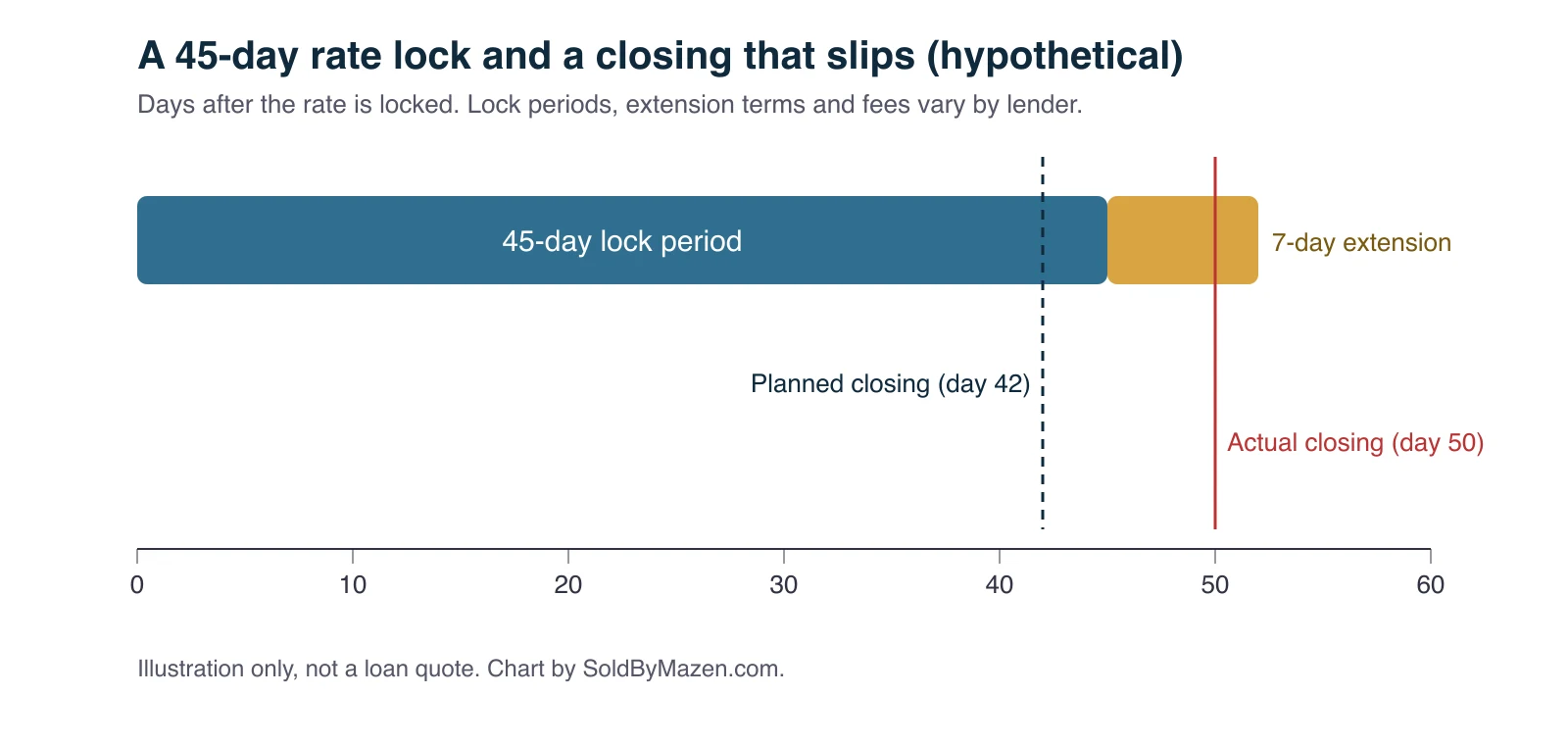
To put a hypothetical extension in dollars: on a $400,000 loan, a fee of 0.125 points would be $500, and 0.25 points would be $1,000. These are illustrations, not typical fees; lenders set their own terms.
For scale, a quarter-point higher rate on the same loan makes a meaningful difference. On a $400,000, 30-year fixed loan, the principal-and-interest payment is $2,769.52 at 7.40% and $2,838.06 at 7.65%, a difference of $68.54 a month. For context, 7.40% was Freddie Mac's national 30-year average in its October 15, 2026, survey. Freddie Mac PMMS
Who pays for an extension depends on the cause of the delay and on your lender's policy. Ask before you lock, not on the day before closing.
Changes that can move a locked rate
A lock covers the loan as it was described when you locked. According to the CFPB, the rate can still change if:
- the loan amount or down payment changes,
- the appraisal comes in higher or lower than expected,
- your credit score changes, or
- income such as overtime or bonuses cannot be verified.
Tell your lender before making changes such as opening new credit, and early about anything else that might change.
Float-down options
Some lenders offer a float-down, which lets you take a lower rate if market rates fall after you lock. Terms vary widely: there may be an upfront cost, a minimum rate drop before it applies, and a window when it can be used. Not every lender offers one, so ask what the terms are and compare the cost with the protection it buys.
What I see with my buyers
In my experience, most buyers don't lock until close to the deadline, because they want to see whether rates improve first. When they do lock, 30 to 45 days covers most of the purchases I work on.
Both choices carry risk. If you wait and rates rise, nothing protects you, and a higher rate raises your payment and can reduce how much you qualify to borrow. If you lock and rates fall, you keep the higher rate unless your lock includes a float-down or your lender agrees to reprice it.
Underwriting is usually the step that takes the longest, and it's the most common reason a closing gets pushed back. When a buyer has a lock in place, we plan the timeline so the closing doesn't run past it. I try to leave at least seven days between the scheduled closing date and the day the lock expires.
I've seen float-down options help buyers more than once, including when I bought my own home.
Before you pay to lock, ask your lender whether they can lock your rate for free. I also suggest asking your loan officer whether they expect rates to go up or down, and why. A knowledgeable loan officer should be watching CPI, PPI, the 10-year Treasury yield and other financial news, the same indicators covered in where mortgage rates may be headed in 2027, and should be able to explain their reasoning.
Questions to ask your lender
- Can you lock my rate at no cost?
- Is my rate locked now? Until what date and time?
- What lock periods are available, and what does each cost in rate or points?
- If closing is delayed, what does an extension cost, and who pays it?
- What happens if the lock expires?
- What could change my rate after I lock?
- Do you offer a float-down, and on what terms?
These questions are not about predicting rates. They make sure the rate you agreed to is the rate you close with.
For buyers in Tacoma and the South Sound, coordinating the lock period with the closing date in your purchase agreement is one of the simpler ways to avoid surprises in the last week of a transaction.
For related reading, see how mortgage points and break-even math work and why mortgage rates don't always follow the Fed.