Mortgage Rate Education
Temporary Mortgage Buydowns Explained: How 2-1 and 3-2-1 Buydowns Work
Decorative graphic based on the payment example in this article; the labeled chart appears below.
A temporary buydown lowers your mortgage payment for the first year or two, sometimes three, and then the payment rises to the full amount for the rest of the loan. In Tacoma and the South Sound, it often comes up when a seller or builder offers a credit toward the buyer's financing.
This guide explains how 2-1 and 3-2-1 buydowns work, what they cost, who can pay for them, and what to check before you agree to one.
What a temporary buydown is
With a temporary buydown, someone pays money up front into an account that covers part of your monthly payment during the early years of the loan. Your loan's note rate does not change. The account simply makes up the difference between the reduced payment and the full payment until the money is used up.
The names describe the schedule:
- 2-1 buydown: the payment is figured at 2 percentage points below the note rate in year one, 1 point below in year two, and the full rate from year three on.
- 3-2-1 buydown: 3 points below in year one, 2 below in year two, 1 below in year three, and the full rate from year four on.
- 1-0 buydown: 1 point below for the first year only.
Fannie Mae, whose rules apply to many conventional loans, caps a temporary buydown at three years, with the borrower's share of the rate rising by no more than 1 percentage point each year. It also requires a written buydown agreement and that the funds be held in a custodial account. Fannie Mae Selling Guide B2-1.4-04 FHA, VA and other loan programs have their own rules, so ask your lender which apply to your loan.
What the payments look like
Here is a hypothetical example. It is an illustration, not a loan quote:
- Loan: $400,000, 30-year fixed, note rate 7.32%.
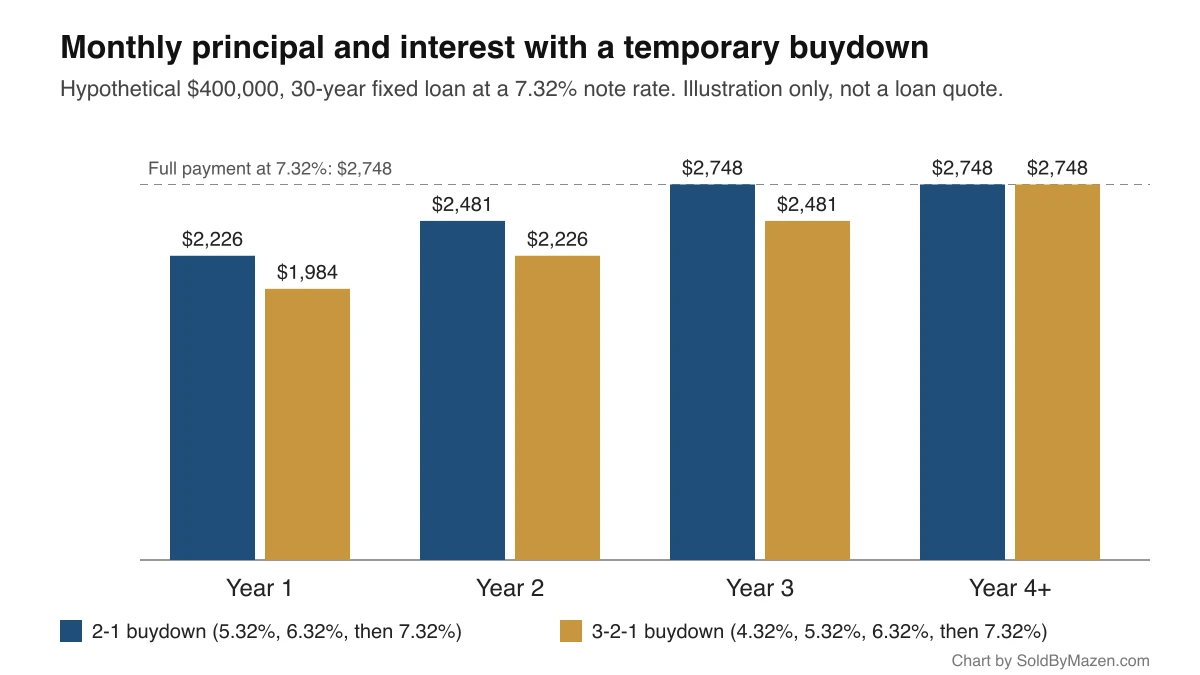
- Full principal-and-interest payment: $2,747.72.
- 2-1 buydown: $2,226.19 in year one (5.32%) and $2,481.11 in year two (6.32%), then $2,747.72.
- 3-2-1 buydown: $1,984.19 in year one (4.32%), $2,226.19 in year two and $2,481.11 in year three, then $2,747.72.
For context, 7.32% was Freddie Mac's national average for a 30-year fixed loan in its October 22, 2026, survey. Freddie Mac PMMS
What a buydown costs
The cost is roughly the total of the payment reductions. In the example:
- 2-1 buydown: about $6,258 in year one plus $3,199 in year two, about $9,458 in total, or roughly 2.4% of the loan amount.
- 3-2-1 buydown: about $9,162 plus $6,258 plus $3,199, about $18,620 in total, or roughly 4.7% of the loan amount.
Your lender calculates the exact amount, and it appears in your loan paperwork. The point is the scale: a 3-2-1 costs about twice as much as a 2-1 on the same loan.
You still qualify at the full payment
A temporary buydown does not make a larger loan affordable on paper. Fannie Mae requires lenders to qualify the borrower at the note rate, not the reduced rate. Fannie Mae Selling Guide B2-1.4-04
That rule is also a useful personal test. If the full payment in year three or four would strain your budget, the lower early payments only delay the problem. Plan around the full payment, and treat the early savings as a cushion for moving costs, furniture or repairs, not as a reason to stretch.
When we negotiate a seller credit, I compare the buyer's payment with the lower rate against the payment if the same money came off the price instead. Usually, the rate wins.
Who pays, and the seller-contribution limit
A seller, a builder or a lender can fund a buydown.
When a seller or builder pays, the cost counts toward the loan program's limit on what interested parties can contribute. For Fannie Mae loans on a primary home or second home, the limit is based on the lower of the price or appraised value: Fannie Mae Selling Guide B3-4.1-02
- 3% when the loan-to-value ratio is above 90%,
- 6% from 75.01% to 90%,
- 9% at 75% or less.
That limit covers everything the seller pays toward your financing and closing costs, not just the buydown. Using the example above, a buyer putting 5% down on a home priced around $421,000 would face a cap of about $12,630, which is less than the roughly $18,620 a 3-2-1 would cost. The same buyer with 20% down on a $500,000 home would have a 6% cap of $30,000. Your lender can confirm the exact limit for your loan before you write it into an offer.
If the credit we'd want is more than the loan program allows, I negotiate the rest as a reduction from the list price.
Temporary buydown or permanent points
A seller credit can pay for a temporary buydown or for permanent discount points that lower the rate for the life of the loan. The trade-off:
- A temporary buydown gives a larger payment reduction for a short time.
- Permanent points give a smaller reduction that lasts as long as you keep the loan.
How much a point lowers the rate depends on the lender and the day's pricing, so the comparison only works with real quotes. Ask your lender to price both options with the same credit amount, then compare the monthly payment in each year and how long you expect to keep the loan. The break-even approach in how mortgage points and break-even math work applies to the permanent option.
Which one I recommend depends on the buyer's situation and what they expect for their finances over the next few years.
For buyers with a temporary buydown, I remind them each year that the payment is about to step up, and I tell them to refinance if it makes sense at the time.
If you sell or refinance early
Buydown funds that have not been used yet do not simply disappear. Under Fannie Mae's rules, if the loan is paid off before the funds run out, the remainder may be credited toward the payoff or returned to the borrower or lender as the buydown agreement specifies. Fannie Mae Selling Guide B2-1.4-04 Read that section of your agreement before closing.
Some buyers choose a buydown hoping to refinance later. A refinance depends on future rates, your finances and the home's value at the time, none of which anyone can promise. The safer plan is a loan you can keep at the full payment.
Builder credits on new construction
Right now, I'm not seeing South Sound builders use specific 2-1 or 3-2-1 language in their offers. Many are offering "flex" credits instead.
If a builder offers a flex credit, ask in writing what it can be used for, how much of it can go toward the rate, and whether it requires the builder's preferred lender.
Questions to ask your lender
- Does my loan program allow a 2-1 or 3-2-1 buydown, and on what terms?
- What is the exact cost of each option on my loan amount?
- How much can the seller contribute in total, given my down payment?
- With the same credit, what would permanent points do to my rate instead?
- What happens to unused buydown funds if I sell or refinance early?
- What will my full payment be, including taxes and insurance, once the buydown ends?
For related reading, see mortgage rate locks explained and why mortgage rates don't always follow the Fed.