Mortgage Rate Education
Mortgage Points Explained: How to Find Your Break-Even
Decorative graphic drawn from the hypothetical example charted below; the labeled chart appears in the article.
Mortgage points let you pay more at closing in exchange for a lower interest rate. Whether that trade pays off depends mostly on one thing: how long you keep the loan before you sell or refinance.
This guide explains what points cost, how to find the break-even, and what the simple calculation leaves out.
What a mortgage point is
A discount point is a fee paid to the lender at closing to lower the interest rate. One point equals 1% of the loan amount, so on a $400,000 loan, one point is $4,000. Lenders also price in fractions of a point, such as 0.5 or 0.375.
There is no fixed rule for how much a point lowers the rate. It depends on the lender, the loan type and market conditions on the day you get a quote. In one Consumer Financial Protection Bureau example, paying 0.375 points lowered a rate from 5.00% to 4.875%. CFPB: discount points and lender credits
The reverse also exists. A lender credit gives you money toward closing costs in exchange for a higher rate. Points and credits are two ends of the same pricing menu.
On your Loan Estimate and Closing Disclosure, points appear on page 2, Section A. Lender credits appear on page 2, Section J, as a negative number. That makes it possible to compare offers line by line.
How to find the break-even
The basic calculation has three steps:
- Find the cost of the points in dollars.
- Find the monthly payment with and without the points, using the same loan amount and term.
- Divide the cost by the monthly savings. The result is the number of months it takes to earn the cost back.
Here is a hypothetical example. It is not a quote, and the rate reduction is an assumption chosen to show the math:
- Loan: $400,000, 30-year fixed.
- Without points: 7.40%, a principal-and-interest payment of $2,769.52.
- With one point ($4,000): 7.15%, a payment of $2,701.63.
- Monthly savings: $67.89.
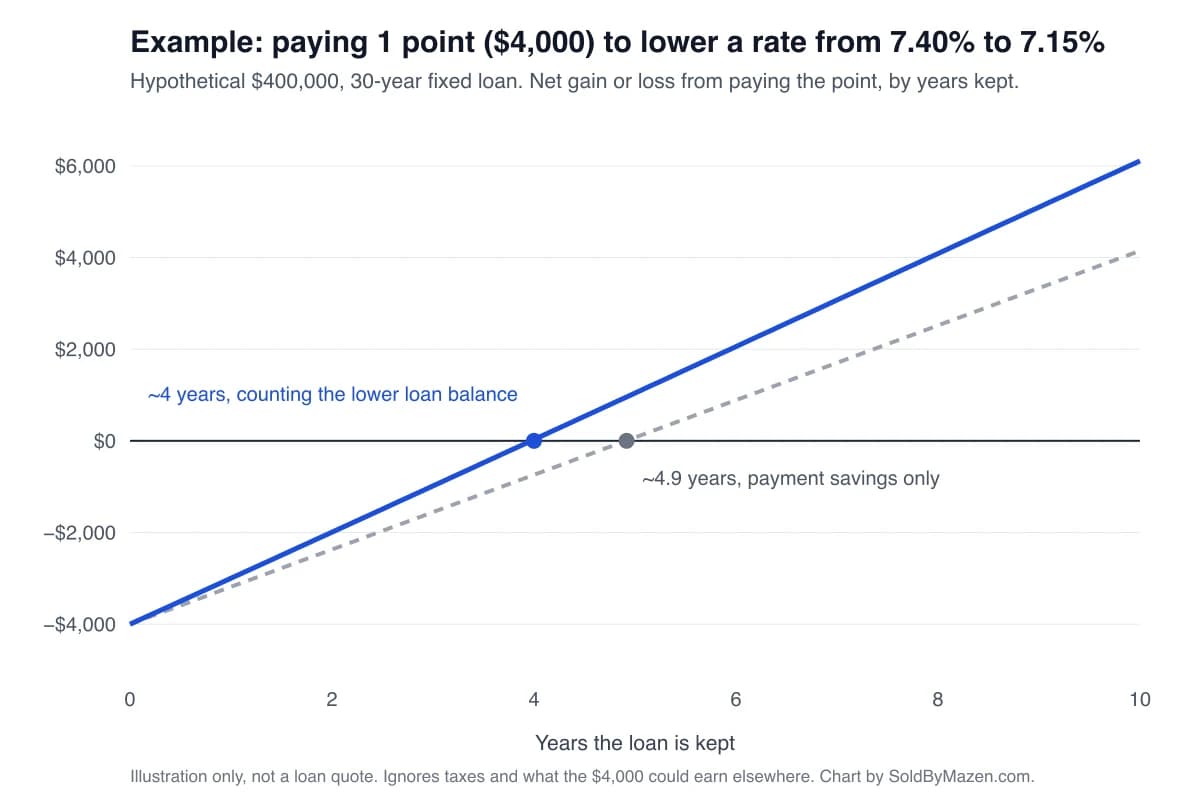
- Simple break-even: $4,000 ÷ $67.89 ≈ 59 months, or just under 5 years.
For context, 7.40% was Freddie Mac’s national average for a 30-year fixed loan in its October 15, 2026, survey. FRED 30-year mortgage series
The lower balance shortens the break-even
The simple calculation counts only the lower payment. A lower rate also means more of each payment goes to principal, so the loan balance falls a little faster.
In the example, the balance is about $770 lower after four years with the point. When you sell or refinance, that difference comes back to you. Counting it, the example breaks even at about 48 months instead of 59.
Here is the net result of paying the point in this example, counting both the payment savings and the lower balance:
- Keep the loan 3 years: about $980 behind.
- Keep it 5 years: about $1,040 ahead.
- Keep it 10 years: about $6,110 ahead.
What the break-even does not tell you
The hard part is not the math. It is the number of years you plug in.
- **Refinancing.** If rates fall and you refinance, the old loan ends early, and so do the savings from the points you paid on it.
- **Selling.** A move earlier than planned has the same effect.
- **Cash at closing.** Money spent on points is not available for reserves, moving costs or repairs after you move in.
- **What the cash could do elsewhere.** The simple break-even ignores any return the $4,000 could have earned.
The CFPB suggests asking a loan officer for options with and without points or credits, and comparing the total cost over the shortest, longest and most likely time you expect to keep the loan. That turns one break-even number into a range, which is closer to how real plans work.
Points versus a larger down payment
Some buyers compare points with putting the same money toward the down payment.
In the example, putting the $4,000 toward the down payment instead lowers the loan to $396,000 at 7.40%. The payment drops by about $27.70 a month, less than half the savings from the point. But the $4,000 goes into your equity rather than to the lender, so you recover it when you sell or refinance.
In this example, the larger down payment comes out ahead if the loan is kept less than about five and a half years. After that, the point comes out ahead. Different rates and prices would move that crossover.
One case can change the comparison: on a conventional loan, putting down less than 20% usually means paying private mortgage insurance. If the extra cash would get you to 20% down, it may remove that cost entirely, which can outweigh a small rate reduction. CFPB: private mortgage insurance
Seller-paid points and taxes
Sometimes a seller agrees to pay some closing costs, and that credit can be used to pay points. Loan programs limit how much a seller can contribute, so ask your lender what applies to your loan before negotiating.
Points can also have tax effects. The IRS allows points on a loan to buy your main home to be deducted in the year paid if several conditions are met, including itemizing deductions. Points on a refinance are generally deducted over the life of the loan. Seller-paid points are treated as paid by the buyer but reduce the home’s cost basis. IRS Topic 504: home mortgage points A tax professional can tell you how this applies to your situation.
Questions to ask your lender
- What rate is available with zero points, and what would one point, half a point and a lender credit look like on the same day?
- What is the dollar cost of each option, and where does it appear on the Loan Estimate?
- How long would I need to keep the loan for each option to break even?
- If I put the same money toward the down payment instead, what changes, including mortgage insurance?
- How long is the rate lock, and what happens to the pricing if closing is delayed?
For buyers in Tacoma and the South Sound, the best answer is the one that fits your own timeline. A realistic estimate of how long you will keep the loan matters more than any rule of thumb.
For the broader rate picture, see why mortgage rates don’t always follow the Fed and where mortgage rates may be headed in 2027.