Mortgage Rate Education
Why Mortgage Rates Don’t Always Follow the Fed
Decorative graphic drawn from the FRED data charted below; the labeled chart appears in the article.
The Federal Reserve does not set mortgage rates. It sets a target range for the federal funds rate, the overnight rate banks charge each other. A 30-year mortgage is priced off longer-term borrowing costs, and those can move in a different direction from the Fed.
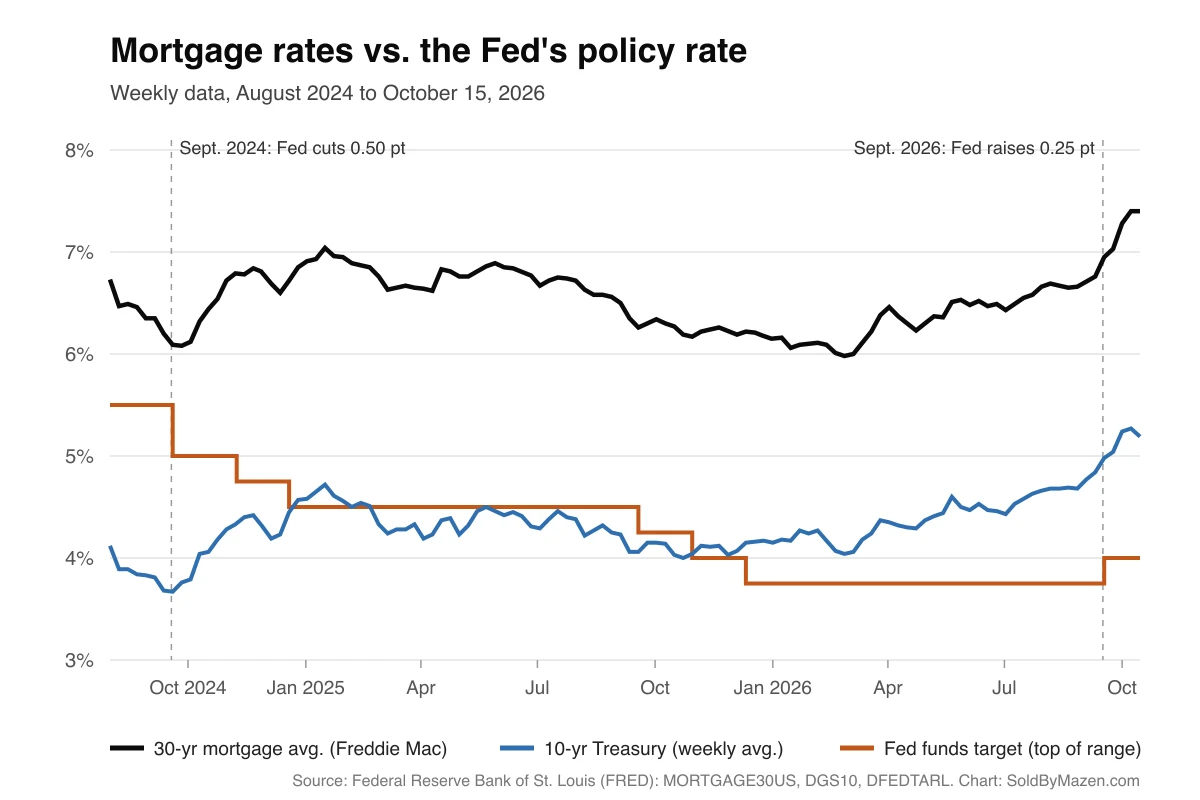
The last two years show it clearly. The Fed cut rates by a full percentage point in late 2024 while mortgage rates rose. In 2026, mortgage rates climbed for months while the Fed held steady, then kept climbing after it raised rates in September.
What the Fed actually controls
On September 16, 2026, the Fed raised its target range by a quarter point to 3.75% to 4.00%, on a 12–0 vote. Its statement said inflation “remains elevated.” Federal Reserve September 16, 2026 statement
That decision directly changes very short-term borrowing costs. It does not set the rate on a 30-year mortgage. A mortgage lender is lending money for years, so it cares about where rates and inflation are expected to be over that longer period.
That is why the 10-year Treasury yield is the more useful benchmark. Economists at the Federal Reserve Bank of Atlanta found that over the past 20 years, mortgage rates tracked 10- and 20-year Treasury yields more closely than the federal funds rate. They point out that most mortgages are paid off or refinanced well before 30 years—often in roughly seven to 10 years—which ties them to longer-term yields. Atlanta Fed: the Fed funds rate and mortgage rates
Late 2024: the Fed cut and mortgage rates rose
On September 18, 2024, the Fed cut its target range by half a point, to 4.75% to 5.00%. Federal Reserve September 18, 2024 statement Two more quarter-point cuts followed in November and December, for a full percentage point by year-end.
Over about the same stretch:
- Freddie Mac’s 30-year fixed average went from 6.09% on September 19, 2024, to 7.04% on January 16, 2025.
- The 10-year Treasury yield, averaged by week, went from 3.67% to 4.72% over the same weeks.
Mortgage rates followed the 10-year yield, not the Fed. One reason is timing: bond markets trade on expectations, so a widely expected cut can already be reflected in yields before the announcement. After that, new information about growth, inflation and the likely path of future policy can push long-term yields up even while the Fed is cutting.
2025: rates fell before the cuts arrived
The Fed made three quarter-point cuts between September and December 2025, bringing its range to 3.50% to 3.75%.
Much of the mortgage-rate decline came first. The 30-year average fell from 6.58% on August 14 to 6.26% on September 18, the day after the first cut. Two weeks later, it was 6.34%. By December 31, it was 6.15%.
In this case, mortgage rates and the Fed moved in the same direction overall. But the timing shows how markets can move ahead of an expected decision, leaving less room for movement once it is announced.
2026: mortgage rates climbed while the Fed held
The Fed kept its range at 3.50% to 3.75% from December 2025 until its September 2026 meeting. Mortgage rates did not hold still:
- February 26, 2026: 5.98%, the lowest weekly average of the year so far.
- September 17, 2026: 6.95%, the day after the hike.
- October 15, 2026: 7.40%.
The 10-year Treasury yield, averaged by week, rose from 4.04% to 4.98% between those first two dates and averaged 5.19% for the week ending October 15. Most of the increase in mortgage rates happened before the Fed acted. FRED 30-year mortgage series FRED 10-year Treasury series
This time, the Fed and mortgage rates moved in the same direction. The order still matters: mortgage rates had already risen about a percentage point while the policy rate was unchanged.
The gap between mortgage rates and Treasury yields
Mortgage rates do not track Treasury yields exactly. Lenders add a spread to cover the cost and risk of making and funding the loan.
The Atlanta Fed article highlights one part of that spread: payoff risk. Many borrowers refinance when rates fall, so investors who buy mortgage-backed securities may get their money back sooner than they wanted. They demand extra yield for that uncertainty.
Using the weekly figures above, the 30-year average was about 2.4 percentage points above the 10-year yield in September 2024, about 1.9 points in February 2026 and about 2.2 points by mid-October 2026. That is a rough comparison: Freddie Mac’s figure comes from a weekly survey, while the Treasury figure is an average of daily yields. It does show that the gap itself changes, which is one more reason the 10-year yield alone does not tell you what a lender will quote.
How to read the next Fed meeting
The Fed’s next meetings are October 27–28 and December 8–9, 2026. The December meeting includes updated economic projections from Fed officials. Federal Reserve meeting calendar
The decision itself is often the least surprising part. A few things tend to be more informative:
- Whether the decision matched what markets expected going in.
- What the statement and press conference say about inflation and future policy.
- In December, how officials’ projections for future rates changed.
- How the 10-year Treasury yield reacts over the following days, rather than the first few hours.
- Whether Freddie Mac’s weekly average moves the same way in the weeks after.
A cut does not guarantee lower mortgage rates, and a hike does not guarantee higher ones. Either outcome depends on whether the decision and the Fed’s outlook change what investors expect about inflation and future rates.
What this means if you are planning a move
For a buyer or seller in the South Sound, the takeaway is practical: a Fed headline does not show what a mortgage will cost. The 10-year Treasury yield is a better daily signal, and an actual lender quote—with its rate, points and lock terms—is the only figure that applies to a specific loan.
For the broader forecast picture, including the latest Fannie Mae and MBA projections and recent inflation reports, see where mortgage rates may be headed in 2027.